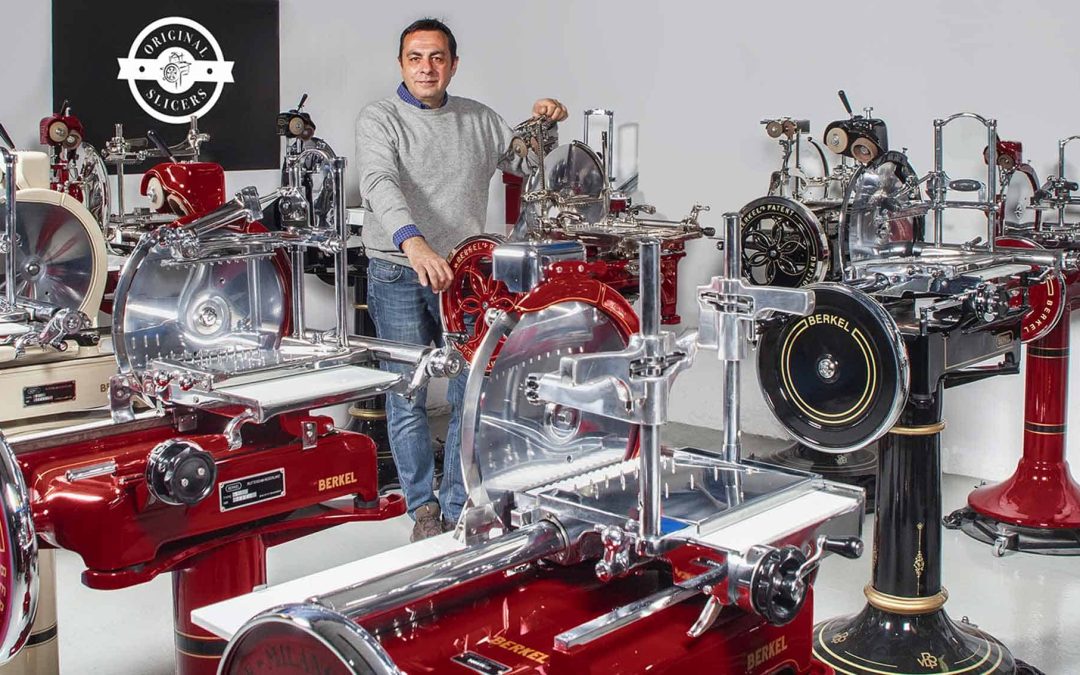
Vintage Berkel slicers require far more than aesthetic refurbishment when they are restored. Working on these historic machines means understanding their mechanics, recognising the characteristics of each model and knowing how every component contributes to the original configuration of the slicer.
At Original Slicers, this expertise has developed over more than 25 years of hands-on work with original Berkel slicers, combining mechanical knowledge, experience in slicer blade manufacturing and specialist craftsmanship.
How Original Slicers developed its expertise in vintage Berkel slicers
At the heart of Original Slicers’ work is an in-depth understanding of slicer mechanics and individual components.
Original Slicers is part of Slayer Blades, an Italian manufacturer specialising in slicer blades. Over the years, the production of blades led the company to acquire original vintage Berkel slicers in order to study their mechanisms and manufacture blades suited to the characteristics of these historic machines.
Working directly on them gradually built increasingly specialised knowledge of vintage Berkel mechanics. This technical expertise was then extended to the recovery and restoration of historic Berkel slicers, eventually leading to the creation of Original Slicers.
Today, that background makes it possible to approach machines built decades ago (some more than 100 years old), with an understanding of how their components and mechanical systems differ according to model and production period.
How a vintage Berkel slicer is assessed before restoration
Every restoration begins with an assessment of the individual machine.
Before any work starts, Original Slicers examines the overall condition of the slicer, its mechanical state, its completeness and the work required to restore its functionality.
This is especially important with antique Berkel slicers, as two machines that appear similar may have had very different histories. Previous restoration work, worn or non-original components, missing parts and later modifications can all affect the type of intervention required.
As Antonio Barra of Original Slicers explains, the first inspection takes place directly on the workbench. Every element, from the smallest screw to the main mechanical components, is checked to establish whether it is original and correct for that particular model.
When a component is missing, Original Slicers can recover original Berkel parts from historic machines that can no longer be restored, using them when necessary to complete a customer’s slicer.
Only after this assessment is the machine dismantled and its components separated according to the work required.
Why knowing the exact Berkel model matters
Berkel produced numerous slicer models over the course of its history, with different mechanical solutions, dimensions, shapes and construction details.
A Berkel Model B, Model 7 and Model 8H, for example, do not share the same configuration. A correct restoration therefore requires more than recognising a component as an original Berkel part: it is also necessary to know whether that component belongs to the specific model being restored.
This model-specific knowledge is particularly important when working on incomplete machines or Berkel slicers that have already undergone work in the past.
What happens during a professional Berkel slicer restoration
Once the initial assessment has been completed, the restoration can involve a number of specialist stages.
Depending on the condition of the machine, these may include dismantling, cleaning, work on mechanical components, replacement with original Berkel parts where required, surface preparation, painting and decoration, polishing, reassembly and final checks.
The work is defined according to the individual slicer rather than applying the same standard process to every machine.
Why Original Slicers controls every stage of the work
The different restoration activities are coordinated at the Original Slicers workshop in Oggiona S. Stefano, Northern Italy.
Managing the process within the same specialist environment allows the team to follow each machine from its initial assessment to final reassembly and to maintain direct control over the quality of the work.
This is particularly important when dealing with an original Berkel meat slicer, where mechanical components, finishes and historical details must be considered as parts of the same machine rather than as separate restoration jobs.
Restoring mechanics without overlooking aesthetics
A restored vintage Berkel slicer often attracts attention because of its colour, decorations, distinctive flywheel and polished metal surfaces.
The visual result, however, is only one part of the restoration. Behind it is a mechanical machine whose components must work together correctly.
Original Slicers therefore approaches restoration by considering both the appearance of the slicer and the functionality of its mechanism.
This balance is particularly evident in restored Berkel flywheel slicers, where the visible craftsmanship and the precision of the manually operated mechanism are equally important.
More than 25 years of hands-on knowledge
The expertise of Original Slicers has been built directly on the machines themselves.
More than 25 years ago, many of the vintage Berkel slicers available to the team were still complete and original. Dismantling them provided the opportunity to study each machine in detail, learning individual components down to the smallest screws and understanding which parts belonged to each model and where they had to be positioned during reassembly.
This practical knowledge remains particularly valuable because complete exploded diagrams or technical drawings identifying every single component are not available for many historic Berkel slicers.
Today the situation has changed. Many antique Berkel slicers arriving for restoration are incomplete. A sharpener, slice thickness adjustment mechanism, product clamp arm or another model-specific component may be missing.
In these cases, knowing the general mechanics of a slicer is not enough. The restorer must be able to identify the component originally intended for that particular model.
As Antonio Barra explains:
“The most important skill of a good restorer is knowing every model and every one of its parts, understanding how the machine was originally built and being able to complete it using the correct original components.”
Why specialist expertise matters when restoring a vintage Berkel slicer
Restoring a historic Berkel means working on a machine whose configuration may have changed over decades of use, maintenance and previous repairs.
Specialist experience makes it possible to assess what belongs to the individual model, identify missing or incorrect components and define the restoration according to the actual condition of the machine.
For Original Slicers, the objective is to restore functionality and appearance while respecting the characteristics and authenticity of each individual Berkel slicer.
Frequently asked questions
Does Original Slicers restore customer-owned vintage Berkel slicers?
Yes. Each slicer is assessed individually before the work is defined. Photographs of the machine can be sent to Original Slicers for an initial evaluation.
Can an antique Berkel slicer be restored if some parts are missing?
It may be possible, depending on the model, condition of the machine and components required. Original Slicers assesses the completeness of each slicer and, where appropriate, can use original Berkel parts recovered from historic machines that can no longer be restored.
Does Original Slicers use original Berkel parts?
Yes. Original Slicers uses exclusively original Berkel components recovered over the years from historic machines that are no longer restorable and preserved for use when required during restoration.
How long does a complete Berkel slicer restoration take?
A complete restoration requires almost 100 hours of work, involving the different stages and specialist skills required.
Dismantling can take approximately half a day and reassembly around a day and a half, but cleaning, polishing, chrome plating, filling, painting, decoration and component checks must also be completed.
Under normal circumstances, the entire process takes approximately four weeks from receipt of the slicer.
How much does it cost to restore a Berkel slicer?
The cost depends on the model, the condition of the machine and the work required. Original Slicers therefore assesses each slicer individually before defining the restoration and providing a quotation.
Would you like Original Slicers to assess your Berkel slicer?
Every machine is evaluated individually to identify the work required and define the most appropriate restoration approach.
Send us photographs of your Berkel slicer and request an initial assessment.